Designing and implementing a cleaning program for your cleanroom can seem daunting. Knowing where to begin or what to include can assist with maintaining the cleanroom long-term and help strengthen sterility assurance of the compounded sterile preparations (CSPs). In this article, we will discuss the top 10 key factors for developing an effective cleaning procedure and maintaining a controlled cleanroom environment.
Types of Chemical Agents
When establishing the protocols for maintaining a cleanroom environment, it is crucial to be familiar with the types of chemical agents required per USP <797> compliance. These agents include cleanroom disinfectants, cleaning chemicals & sporicidal agents, each serving distinct purposes essential for upholding the cleanliness of the cleanroom.
Cleaning
The process of cleaning involves eliminating organic or inorganic substances such as dirt, debris, microbes, and residual drugs or chemicals, from surfaces. This is achieved through either a manual or mechanical process and using a cleaning agent. A cleaning agent typically contains a surfactant, which reduces the chemical agent’s surface tension, thereby increasing its spreading and wetting properties. The cleaning process is conducted to remove substances that may interfere with a disinfecting agent’s effectiveness.
Disinfecting
The process of disinfecting involves the destruction of microorganisms, typically achieved through the use of a chemical agent. A disinfecting agent, whether chemical or physical, is utilized on inanimate surfaces and objects to destroy fungi, viruses, and bacteria.
Sporicidal
The process of applying a sporicidal disinfectant involves the destruction of bacterial and fungal spores. A sporicidal agent is a chemical or physical agent capable of destroying bacterial and fungal spores when used at a sufficient concentration for a specified dwell time. A sporicidal agent is expected to kill all vegetative microorganisms.
Chemical Agent Selection
When determining which chemical agent to use, the following factors should be taken into account to ensure the effectiveness of the overall process.
Kill Spectrum
The kill spectrum refers to the range of microorganisms the chemical agent is effective against. When deciding which kill spectrum the chemical agent should cover, consider the types of microorganisms that are likely to be present in the environment. For example, in a cleanroom setting, thought should be given to microorganisms that may be brought in by personnel (i.e. Micrococcus luteus) or from the surrounding environment (Bacillus species).
Dwell Times
The dwell time of a chemical agent is the amount of time that is needed for the chemical agent to remain in contact with a surface to effectively eliminate microorganisms. It’s crucial to adhere to the specified dwell times for chemical agents to ensure their effectiveness.
Compatibility
The compatibility of a chemical agent with the materials to be cleaned and disinfected should be assessed. Damage to surfaces caused by incompatible agents may render the surface no longer smooth or impervious, which allows microorganisms and other contaminants to accumulate.
Safety
Personnel safety regarding toxicity, potential health hazards, and the need for specific personal protective equipment (PPE) should be carefully evaluated.
Sterility
For the Primary Engineering Control (PEC), USP <797> states that the chemical agents must be sterile, and for classified areas outside of the PEC, the chemical agents should be sterile. When deciding whether to use a sterile agent, a risk assessment should be conducted with the justification documented. It is important to note that using a sterile disinfectant reduces the potential for introducing additional contaminants, as with some disinfectants gram-negative bacteria can survive or grow in them.
Frequency of Chemical Agent Use in Cleanrooms
Per USP <797>, the frequency of use for each type of chemical agent depends on the category of the compounded sterile preparations (CSPs) being prepared in the cleanroom. The following table provides an overview of the minimum frequency required for cleaning, disinfecting surfaces, and applying sporicidal disinfectants in classified areas and in the SCA (Segregated Compounding Area)a.
| Site | Daily | Weekly | Monthly |
|---|---|---|---|
| PEC(s) and equipment inside the PEC(s): This includes all interior surfaces of the PEC | On days when compounding occurs and when surface contamination is known or suspected:
|
Applying Sporicidal Disinfectant (entities compounding Category 3 CSPs) | Applying Sporicidal Disinfectant (entities compounding Category 1 and/or Category 2 CSPs) |
| Removable work tray of the PEC, when applicable | The work surface of the tray daily on days when compounding occurs:
|
N/A | All surfaces and the area underneath the work tray:
|
|
On days when compounding occurs
|
Applying Sporicidal Disinfectant (entities compounding Category 3 CSPs) | Applying Sporicidal Disinfectant (entities compounding Category 1 and/or Category 2 CSPs) |
|
N/A | N/A |
|
| Surfaces of Sink(s)b | When in use:
|
N/A | Applying Sporicidal Disinfectant |
a Ceilings of the SCA are required to be cleaned, disinfected, and applied with sporicidal disinfectant only when visibly soiled and when surface contamination is known or suspected.
b Refer to USP <797> Section 4.4. Water Sources for specifics on the cleaning and placement of sinks.
Following cleaning and disinfecting, or applying a sporicidal agent to the PEC, sterile 70% IPA is to be applied to remove any residue. Sterile 70% IPA must also be applied immediately before initiating compounding, and to the work surface (including any removable trays) at least every 30 minutes during the compounding process, if the compounding process takes 30 minutes or less. If the compounding process takes longer, the work surface is to be disinfected immediately after compounding.
Many disinfectants approved by the Environmental Protection Agency (EPA) are classified as one-step cleaning and disinfecting agents. This classification denotes that the disinfectant has been specially formulated to be effective in the presence of light-to-moderate soiling without requiring a separate cleaning step.
Method
When establishing a cleaning method for the cleanroom, the approach for cleaning equipment, ceilings, walls, tables, floors, and other surfaces should be defined. This approach may include how each type of surface will be cleaned, i.e. whether personnel will use a cleanroom mop, isolator cleaning tool, or cleanroom wipe, and when the item is to be discarded and or replaced during the process. When cleaning a surface, it’s recommended to use unidirectional overlapping strokes (rather than wiping or mopping in circles) to effectively remove any potential substances.
Direction and Order of Cleaning
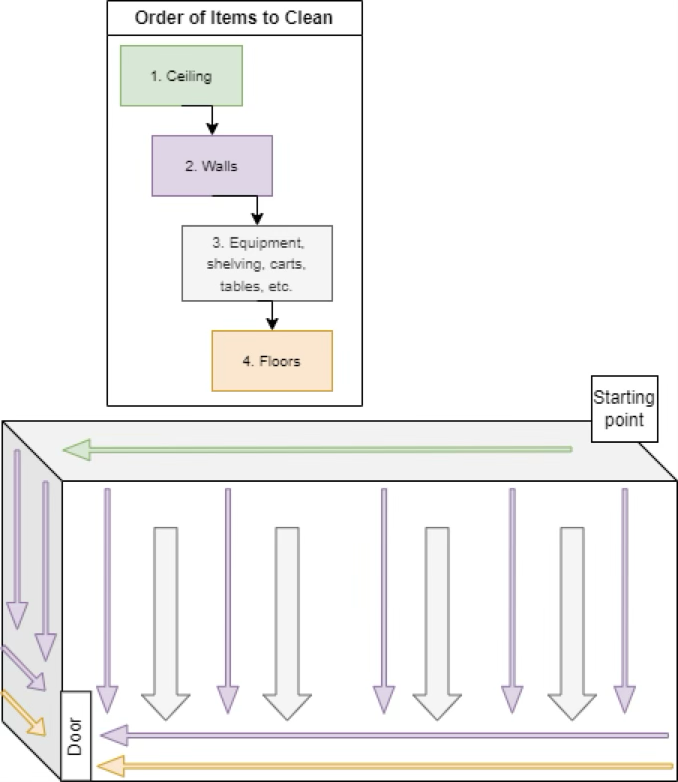
The direction and order the cleaning is performed begins with the cleanest areas and progresses towards the dirtiest, while also following a top-to-bottom, back-to-front sequence. This sequence should be practiced anytime cleaning is conducted within the cleanroom. During monthly cleaning, however, that approach may change slightly, as the PEC may not be selected to be cleaned first, but rather the ceiling.
To provide further clarification, the following is an example of monthly cleaning direction and order in a cleanroom:
- Start at the corner or side of the ceiling farthest from the door, using unidirectional, overlapping strokes to ensure thorough coverage, working towards the door.
- Proceed to clean the walls in the same manner as the ceiling.
- Clean any equipment, shelving, carts, tables, or additional items in the cleanroom following the cleanest to dirtiest, top-to-bottom, back-to-front sequence.
- Once all items/ areas in the cleanroom have been cleaned, proceed to mop the floor, starting from the point farthest from the door and working towards the door.
Below is a visual representation of the previous example regarding the direction and order of monthly cleaning:
Supplies
When it comes to supplies, a variety of items are used to ensure that the process is effective and meets the necessary standards. These supplies may include mops, sponges, wipes, mop pads, etc. The material of the supplies, except for tool handles or holders, must be low lint. Supplies used in a PEC, except for tool handles and holders, must be sterile. Disposable items should be discarded after each cleaning activity and any reusable items should be made of a nonporous material that can be easily cleaned and disinfected before and after each use. When selecting a mop, it is advisable to choose one that is easy to maneuver and lightweight, as this makes cleaning areas, i.e. the ceiling, easier to accomplish.
PPE Selection
PPE not only helps mitigate the potential risk personnel pose to CSPs but also helps protect personnel from potential exposure to chemical agents. Examples of this may include goggles and respirators.
Goggles
Cleanroom goggles safeguard the eyes during the preparation and use of chemical agents. Examples of scenarios where goggles are particularly useful include:
- Mixing/dilution or other similar activities where splashing could occur
- Cleaning activities i.e. the ceiling, where excess solution from mop pads may drip
Respirations
Respirators protect personnel from breathing in air that may be contaminated with harmful dusts, fogs, fumes, mists, gases, smokes, sprays, or vapors. Exposure to certain chemical agents could potentially lead to chronic respiratory problems, allergic reactions, or headaches,
The requirements stated in USP <797> regarding PPE still apply during cleaning activities. Proper fit of PPE is crucial to avoid potential exposure to chemical agents and reduce the risk of adding contaminants to the controlled environment.
Written procedures
Procedures for cleaning, disinfecting, and applying sporicidal agents must be described in Standard Operating Procedures (SOPs), in accordance with the manufacturer’s instructions. These Written procedures include personnel training and additional training when changes occur, PPE requirements, facility-approved agents, method, frequency, and location of activities. All cleaning personnel are required to follow these written procedures.
Training of Personnel
Training is crucial for all aspects of sterile compounding, and cleaning is no exception. Written procedures should be read and understood by personnel performing this process. Having multiple types of training methods (i.e. hands-on, demonstrations, on-the-job, etc.) may assist in comprehension for personnel and strengthen consistency that tasks are performed..
Monitoring of the Cleanroom Environment
Monitoring of the environment helps identify if the cleanroom is in a state of control, meaning that the engineering controls are providing the specified level of air cleanliness, processes are being followed, training and chemical agents are effective, and overall environmental quality is being maintained. The data produced from monitoring can help identify areas where process improvements may need to be implemented.
Understanding these key factors when developing your procedures can lead to a robust cleaning program and increased confidence in the cleanroom environment.
References:
- USP. <797> Pharmaceutical Compounding—Sterile Preparations.
- CDC.Guideline for Disinfection and Sterilization in Healthcare Facilities (2008)
- Insanitary Conditions at Compounding Facilities Guidance for Industry (November 2020)
- OSHA. 1910.134 Respiratory protection.