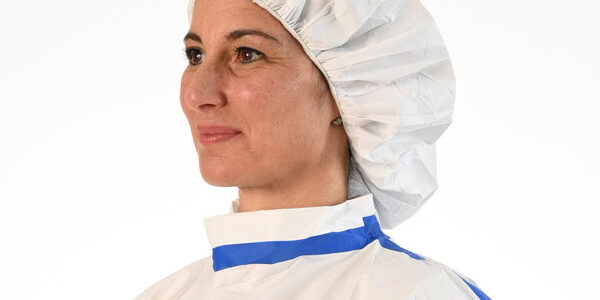
A bouffant cap that splits at the elastic during donning never costs just one cap. It costs a second cap and a repeated garbing step. Worse, hair sits exposed at the hood line while someone fixes it. Repeat that across every gowning on every shift and the lowest-priced case on the quote stops being the cheapest option. Buying disposable bouffant caps on case price alone is how facilities end up paying more.
The number worth tracking is cost per gowning, meaning the total spent on caps to get one person fully and correctly covered. Below is how to judge cap quality, where a higher spec earns its price, and how to match the cap to the room it’s going into. This doesn’t replace your facility’s policies or regulatory requirements.
Cost Per Gowning Is the Number That Matters
Case price is easy to compare. It’s also the wrong comparison.
Why the Case Price Misleads
A lower-priced case only saves money if every cap in it does its job once. In practice, a thin cap tears at the band, an undersized cap gets doubled, or a cap that slides back gets replaced mid-shift. Each of those turns one unit into two, and none of them shows up on the purchase order.
There’s also a cost procurement doesn’t see. A doubled cap means a gowning step done twice. In a sterile compounding suite, that’s time spent in the anteroom instead of at the primary engineering control.
Where Spending More Is Justified
Sterile, individually packed caps earn their price in ISO Class 5 work and in any room where your SOPs call for sterile garb. Outside those areas, the higher spec buys protection the room doesn’t need. Sterile caps stocked in an unclassified gowning area or an ISO Class 8 support room are one of the easiest budget leaks to close.
Four Quality Markers to Check Before You Reorder
Two caps can look identical in the box and perform very differently on the gowning bench. These four details separate disposable bouffant caps that last through a shift from caps that get replaced halfway through it.
Material
Spunbond polypropylene is the workhorse material for bouffant caps. It’s lightweight, breathable, and low-linting, which makes it a fit for most non-sterile cleanroom work.
Flashspun polyethylene caps have a smoother, tighter surface that resists abrasion and sheds fewer fibers. That durability pays off in higher-grade rooms and on long shifts where staff adjust their caps under a hood. The tradeoff is breathability. In a warm gowning room, a heavier cap gets touched more, and every adjustment puts a gloved hand near the face.
Size and Coverage
Bouffant caps are sized by flat diameter, with 21, 24, and 28 inch as the standard steps. A 21 inch cap covers short hair. Longer or thicker hair needs a 24 or 28 inch cap to stay fully contained without the band riding up.
Undersizing is the main reason staff double up. The fix is simple. Stock two sizes at the gowning station instead of one.
Oversizing causes its own problems. A cap that’s too large bunches at the back of the head and can push a hood or coverall collar out of position, which opens the same gap the cap was supposed to close.
Elastic Band
The band is where low-cost caps fail first. Look for elastic that’s fully enclosed in the cap fabric, with seams that hold when the cap is stretched over the head.
Fit matters as much as construction. A band that’s too tight causes headaches, so people loosen it or pull it back. One that’s too loose lets the cap slide and expose the hairline right where the hood or coverall collar starts.
Sterility and Packaging
Caps are sold non-sterile in bulk, non-sterile and individually packed, or sterile and individually packed. Packaging deserves as much attention as sterility, and you can compare all three formats across our bouffant caps.
An open bulk case in a gowning area collects particles every time someone reaches in, so the last caps in the box aren’t as clean as the first. Individually packed caps cost more per unit but stay sealed until the moment they’re used. For ISO Class 7 areas where your SOPs don’t require sterile caps, individually packed non-sterile caps are a practical middle ground.
Matching the Cap to Your Environment
The right spec depends on what the room protects. Here’s how that plays out by facility type.
Sterile Compounding and Hospital Oncology (USP 797 and USP 800)
USP 797 includes head and facial hair covers in the garbing sequence for sterile compounding. USP 800 layers hazardous drug handling requirements on top of that. Your facility’s SOPs define whether caps must be sterile and where they go on in the sequence.
Individually packed caps fit this workflow well because the cap stays sealed until it’s donned in the anteroom. In hazardous drug areas, treat a used cap as contaminated PPE and dispose of it according to your hazardous drug waste procedures.
Biotech and Life Science Labs
Labs newer to formal gowning tend to start with whatever hair cover is on the shelf. That holds up until the room gets classified or a procedure moves into tighter aseptic conditions.
Match the cap to the room class first. Non-sterile polypropylene caps suit most ISO Class 7 and 8 lab work. Aseptic procedures and ISO Class 5 work call for sterile, individually packed caps. If the lab shares a gowning area with a classified suite, stock to the stricter room. Two cap types at one station invites the wrong cap going into the wrong room.
Electronics and Semiconductor Manufacturing
On an electronics line, the concern is particles, not microbes. Sterility adds cost here without adding protection. Low linting is the spec that matters, which puts material choice front and center. Flashspun polyethylene caps shed less than spunbond polypropylene, a difference that counts in tighter ISO classes and on lines where one fiber can scrap a part.
In food processing, a disposable bouffant cap replaces an open-mesh hair net in packaging rooms and QC labs where full coverage matters.
When a Bouffant Isn’t Enough
Beards don’t fit under a bouffant. Facial hair needs its own clean room beard cover, worn alongside the cap.
For staff with long or thick hair, and in rooms where your SOPs call for full head coverage, disposable cleanroom hoods cover the head, neck, and shoulders in one piece. A hood also closes the gap at the coverall collar, where a bouffant alone leaves hair and skin exposed. For the order everything goes on, see our full cleanroom garbing list.
Frequently Asked Questions
A bouffant hair net is open mesh. It holds hair in place but lets short hairs and skin flakes pass through. A disposable bouffant cap is made from nonwoven fabric that fully contains hair and sheds very little lint, which is why cleanrooms use caps instead of nets.
A 21 inch cap fits short hair. Move to 24 or 28 inch for long or thick hair, or for staff who wear their hair up. If people are doubling caps, the size is too small, and switching up saves more than it costs.
USP 797 requires hair covers as part of garbing, and your facility’s SOPs set whether they must be sterile. Sterile, individually packed caps are the safer choice for ISO Class 5 work. Non-sterile caps fit support areas when your SOPs allow them.
Place Your Bouffant Order in 30 Minutes
The goal is one cap per gowning, matched to the room it’s used in. Get that right and a higher unit price can still lower what you spend. Cleanroom Connection’s team is trained in USP 797 and USP 800 and knows how cap material, size, and packaging line up with each area of a compounding facility.
Add disposable bouffant caps to your quote list and receive pricing within 30 minutes.